
Jaishankar Warns of Global ‘4F Crisis’ as Wars Threaten Food, Fertilizer, Fuel and Financial Security
- Internationl
- (Asia/Kolkata)
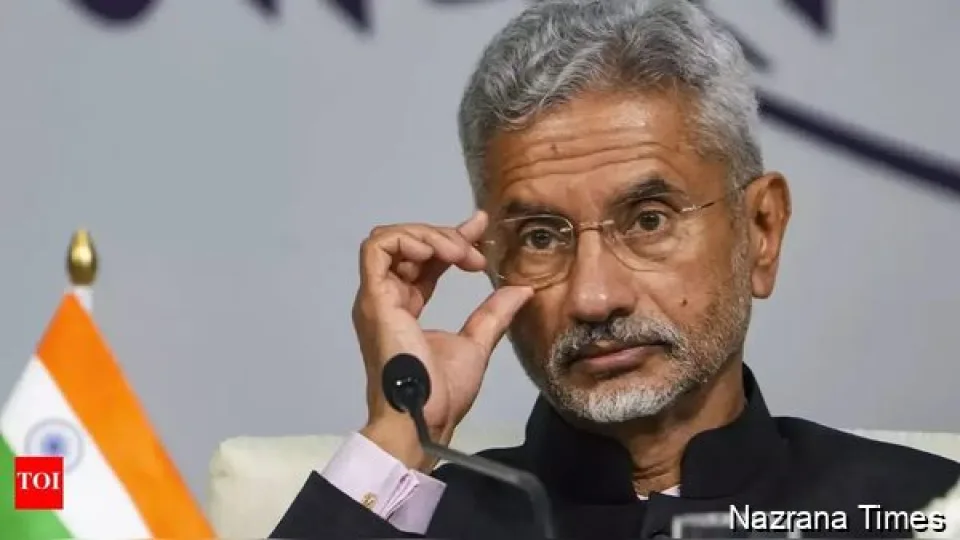
Rising geopolitical tensions could disrupt global supply chains, fuel inflation and increase economic pressure on developing nations, including India.
NEW DELHI (Nazrana Times): India’s External Affairs Minister Dr. S. Jaishankar has highlighted four major challenges confronting the global economy—Food, Fertilizer, Fuel and Finance—collectively described as the “4F” concerns, amid growing geopolitical tensions, ongoing military conflicts and uncertainty in international trade.
His warning comes as the prolonged Russia-Ukraine war and instability in the Middle East continue to raise concerns about energy supplies, agricultural production, international shipping routes and financial stability.
The four interconnected challenges could have significant consequences for developing economies, particularly countries dependent on imported energy, agricultural inputs and international financing.
Food Security: Global Conflicts Threaten Agricultural Supply Chains
Military conflicts and disruptions to international transportation networks can affect agricultural exports, food distribution and global commodity prices.
The Russia-Ukraine conflict has demonstrated the vulnerability of international grain markets to geopolitical instability. Both countries have historically played important roles in global agricultural trade.
Further disruptions to shipping routes or agricultural production could increase food prices, particularly in import-dependent countries.
For developing nations, rising food prices could place additional pressure on household budgets and government spending.
Fertilizer Supplies: Energy Disruptions Could Raise Farming Costs
Fertilizer production is closely connected to global energy markets, particularly natural gas, which is an essential input in manufacturing nitrogen-based fertilizers.
Disruptions to natural gas supplies or increases in energy prices can raise fertilizer production costs and affect international availability.
Higher fertilizer prices could increase agricultural expenses, reduce affordability for farmers and potentially influence future crop production.
Countries dependent on imported fertilizers and raw materials would be particularly exposed to prolonged disruptions.
Fuel Security: Rising Oil Prices Could Challenge India’s Economy
India imports a substantial proportion of its crude oil requirements, making its economy sensitive to fluctuations in international petroleum prices.
Any major escalation of conflict in the Middle East could threaten energy transportation routes and contribute to volatility in global oil and gas markets
Higher crude oil prices could increase India’s import bill, put pressure on the rupee and raise transportation and manufacturing costs.
These developments could also contribute to inflation, affecting businesses and consumers.
However, the actual economic impact would depend on the duration of disruptions, international oil prices, exchange rates and government policy responses.
Finance: The Fourth Challenge Facing the Global Economy
The fourth concern identified in the 4F framework is financial stability.
Prolonged geopolitical uncertainty can discourage investment, increase borrowing costs and create volatility in financial markets.
If food, fertilizer and energy prices remain elevated, households may have less disposable income available for savings and other purchases.
Businesses could simultaneously face higher production expenses, weaker consumer demand and more expensive financing.
Such pressures could slow economic activity, particularly in developing countries already facing debt burdens or limited fiscal resources.
Is India’s Economy Heading Towards a Major Crisis?
The growing international uncertainty has raised questions about India’s economic resilience and its ability to withstand prolonged external shocks.
Concerns include the country’s dependence on imported crude oil, fluctuations in financial markets, international trade disruptions and the possible consequences of geopolitical tensions.
However, claims that India’s economy is already experiencing negative growth or is on the verge of collapse are not supported by the official economic indicators cited in this report.
According to India’s official GDP figures released in August 2026, the economy recorded real growth of approximately 7.8% during the April–June 2026 quarter.
Although strong GDP growth does not eliminate economic vulnerabilities, it is important to distinguish between measurable economic performance and predictions of a future financial crisis.
An extended period of high energy prices, weaker international demand or disruptions to global trade could still affect India’s economic outlook.
Middle East Conflicts Add to Global Economic Uncertainty
The Middle East remains strategically important to global energy production and international maritime trade.
Any escalation involving major regional powers or disruptions affecting important shipping corridors could influence oil prices, commercial transportation and international investment.
Meanwhile, tensions involving China and Taiwan, as well as unresolved disputes between India and Pakistan, represent additional geopolitical risks.
These potential flashpoints should not, however, be treated as evidence that further wars are inevitable.
The economic consequences would depend on whether tensions escalate into actual disruptions to trade, energy supplies or financial markets.
Jaishankar Emphasises International Cooperation
During his September 2026 diplomatic engagements, including discussions at the United Nations, Jaishankar highlighted the pressures facing developing countries as a result of global instability.
His broader message focused on the need for stronger international cooperation, resilient supply chains and greater attention to the economic consequences of geopolitical conflicts.
The interconnected nature of food, fertilizer, fuel and financial markets means that disruption in one sector can rapidly affect others.
For example, higher energy prices can increase fertilizer production costs, which may subsequently influence agricultural expenses and food prices.
Such developments can also contribute to inflation and place pressure on public finances.
Global Economic Stability Faces a Critical Test
The international economy faces significant uncertainty as military conflicts, trade disruptions and geopolitical rivalries continue to affect global markets.
For India, maintaining economic stability will depend partly on domestic policies, energy diversification, investment conditions and the country’s ability to manage external shocks.
While Jaishankar’s 4F warning highlights genuine economic vulnerabilities, it does not establish that India or the wider global economy is heading towards an inevitable collapse.
The central challenge for governments is to strengthen food and energy security, protect vulnerable populations and maintain financial stability while navigating an increasingly uncertain international environment.





Leave a Reply