
Lahore Tops Global Major-City Pollution Ranking as AQI Reaches 344
- Internationl
- (Asia/Kolkata)
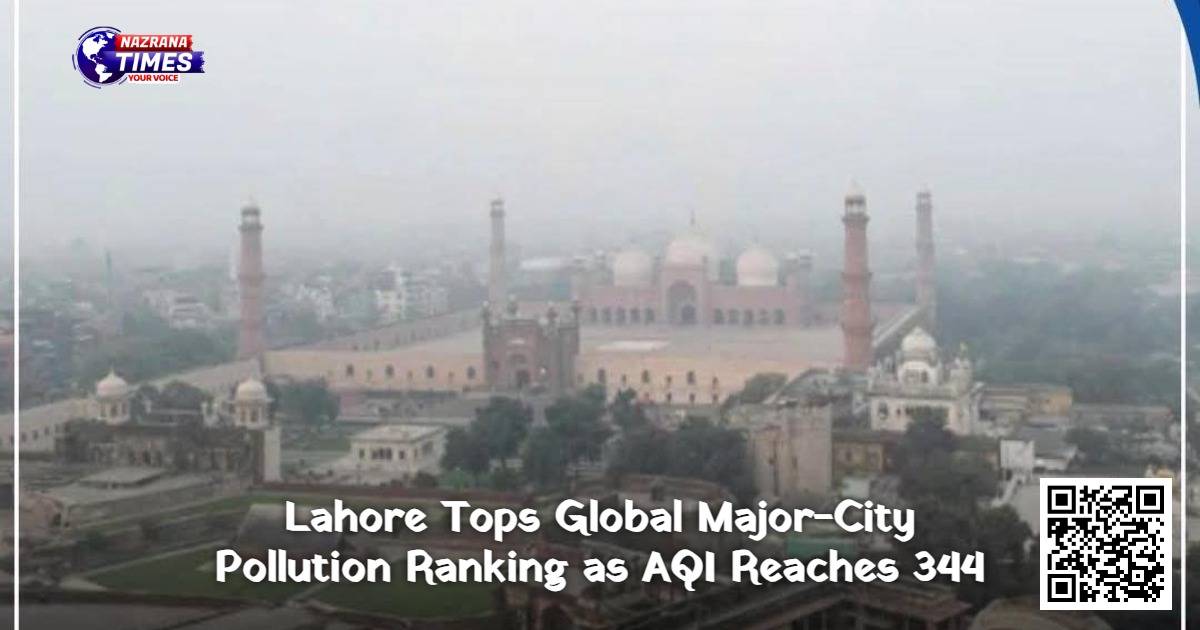
LAHORE (Nazrana Times): Lahore ranked first among the world’s most polluted major cities in readings captured around 8am on Friday, recording an Air Quality Index (AQI) of 344, classified as hazardous.
According to Swiss air-quality monitoring platform IQAir, the city’s main pollutant was fine particulate matter known as PM2.5. Its concentration was recorded at 57 times the World Health Organization’s annual guideline. This comparison concerns a current reading against an annual guideline, rather than Lahore’s annual average.
New Delhi Ranks Second
New Delhi ranked second with an AQI of 244, placing its air in the “very unhealthy” category.
Other major cities included Dakar, Senegal, at 184; Mumbai at 179; and Kolkata at 172. All three recorded “unhealthy” air quality. The rankings reflect readings at a particular time and can change as conditions shift.
Iqbal Town Records AQI of 535
Pollution levels varied considerably across Lahore. Iqbal Town recorded the highest AQI at 535, followed by Airwash on Bedian Road at 497 and Kahna at 446.
Defence Phase 5 recorded 360, Model Town 350 and Barki Road 253, highlighting severe but uneven pollution across the city.
Fine Particles Pose Serious Health Risks
PM2.5 particles are small enough to penetrate deep into the body and enter the bloodstream. Exposure increases the risk of stroke, heart disease, lung cancer and chronic respiratory illnesses.
According to the report, doctors advised residents to wear masks amid the hazardous conditions. Cooler seasonal conditions are trapping pollutants close to the ground, combining crop-residue smoke, vehicle emissions, industrial fumes and construction dust.
A Recurring Regional Crisis
Smog remains a recurring problem across the region. Crop-stubble burning in neighbouring Punjab and Haryana is frequently cited as a contributor to Delhi’s seasonal pollution.
UNICEF has warned that polluted air increases children’s risk of acute respiratory infections. A 2023 study found that air pollution could reduce life expectancy by more than five years in parts of South Asia.
Across the region, smog disrupts livelihoods and daily routines, forcing school closures, slowing transport and placing additional pressure on health services.






Leave a Reply