
From ‘Do More’ to ‘Help More’: Pakistan’s Diplomatic Role Expands
- Internationl
- 23 Mar, 2026 09:52 PM (Asia/Kolkata)

US, Iran Reportedly Close to High-Level Talks in Islamabad as Pakistan’s Role Shifts from ‘Do More’ to ‘Help More’
Lahore Nazrana Times Ali imran Chattha
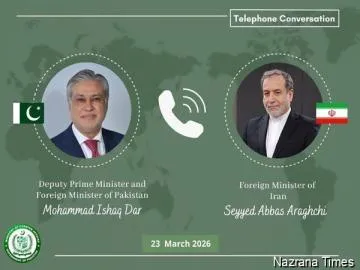
Diplomatic efforts to broker direct engagement between the United States and Iran have reached a critical juncture, with a high-level meeting tentatively scheduled for later this week in Islamabad, according to regional officials and diplomatic sources.
The talks—if they proceed—would mark a significant acceleration in back-channel mediation that has been quietly underway for months, with Pakistan emerging as an unexpected facilitator. Sources familiar with the preparations say the potential U.S. delegation could include Vice President JD Vance, alongside senior White House envoys. Iran is expected to be represented by senior officials from its foreign policy establishment, possibly including Parliament Speaker Mohammad-Bagher Ghalibaf.
Fifteen-Point Framework
The discussions are reportedly structured around a fifteen-point framework that has been provisionally agreed upon through intermediaries. According to statements attributed to former U.S. president Donald Trump, who remains involved in shaping U.S. foreign policy discussions, the agreement would include a commitment by Iran to abandon its nuclear weapons program, though the full scope of the fifteen points has not been made public.
U.S. officials have described the progress as substantial, with one senior administration source characterizing the talks as “the most advanced direct engagement with Tehran in years.”
However, Iranian officials have publicly struck a more cautious tone. The Iranian foreign ministry denied that direct negotiations have taken place, describing American statements as an effort to influence energy markets. The contradictory messaging has left diplomats in Islamabad uncertain whether the planned meeting will materialize as envisioned.
Israel’s Surprise
The speed of the rapprochement has reportedly caught Israel off guard. An Israeli official familiar with the mediation efforts confirmed that while Jerusalem was aware of Pakistan’s role as an intermediary, the advanced stage of the talks came as a surprise.
“We knew there were contacts. What we did not anticipate was how quickly the two sides appear to have moved toward a direct meeting,” the official said, speaking on condition of anonymity.
Israeli officials are said to be seeking clarification from Washington on the details of any potential agreement, particularly regarding its implications for regional security and Iran’s nuclear activities.
Pakistan’s Evolving Role
For Pakistan, hosting such a meeting represents a dramatic departure from the dynamic that defined U.S.-Pakistan relations for much of the past two decades. Under previous U.S. administrations, Pakistan was frequently pressed to “do more” in counterterrorism operations—a phrase that became shorthand for an often fraught partnership.
The current U.S. approach, as outlined in the 2025 National Security Strategy, signals a strategic shift. Washington has moved away from demanding Pakistan act as a frontline combatant in U.S.-led campaigns, instead positioning itself as an “enabler” and seeking to reengage Islamabad as a regional security partner.
“The shift from ‘do more’ to ‘help more’ is real,” said a Pakistani foreign ministry official who spoke on condition of anonymity due to the sensitivity of the talks. “For years we were told to act according to American priorities. Now they are asking us to provide a space for diplomacy. It is a different kind of relationship.”
Challenges Ahead
Even if the Islamabad meeting proceeds, significant obstacles remain. Trump has publicly expressed uncertainty about whether Iran’s new supreme leader, Mojtaba Khamenei, is fully in control of the country’s decision-making, adding a layer of unpredictability. Hardliners in both Washington and Tehran have signaled opposition to direct engagement.
Meanwhile, diplomats in Islamabad continue preparations. Meeting rooms at the Prime Minister’s Secretariat have been readied, and logistical arrangements are being finalized—though officials stress that no formal confirmation has been issued by either government.
“The door is open, but it may not open this week,” a Pakistani diplomat said. “What is significant is that for the first time in a long time, both sides are looking at the same door.”


Leave a Reply