Pakistan and Saudi Arabia Seal Defence Pact, Reshaping Gulf Security
19 Sep, 2025 07:24 AM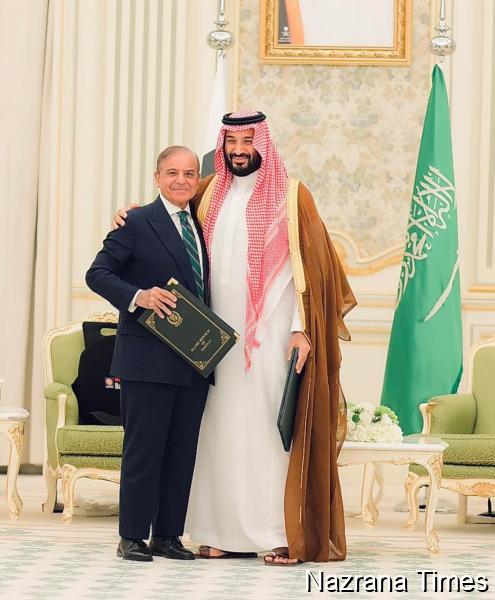
Pakistan–Saudi Defence Pact: A New Security Axis in the Region
Grand Welcome for Prime Minister Shehbaz
Nazrana Times Ali Imran Chattha
Prime Minister Shehbaz Sharif’s arrival in Riyadh was marked by a show of ceremony that went far beyond protocol. His aircraft was escorted by Saudi Royal Air Force jets, a powerful gesture of respect. At Al-Yamamah Palace, he was received on a red carpet by Crown Prince Mohammed bin Salman, with a full military guard of honour and national anthems played. Pakistan’s Army Chief, Field Marshal Asim Munir, joined the ceremony, underlining the military’s central role in shaping the agreement. The optics made clear that this was no ordinary state visit—it was a moment of strategic realignment.

The Strategic Mutual Defence Agreement
The agreement signed between the two countries commits each to respond jointly to any act of external aggression. It also promises expanded cooperation in military training, intelligence sharing, and joint exercises. While formalizing decades of behind-the-scenes cooperation, the pact goes further by placing Pakistan and Saudi Arabia under a collective defence framework similar in tone to NATO’s Article 5. Yet it is deliberately vague about the mechanics of response, leaving both flexibility and uncertainty in its application.
Why the Pact Matters for Pakistan
For Islamabad, the deal represents both prestige and leverage. Aligning with the Kingdom elevates Pakistan’s role from South Asian actor to Middle Eastern stakeholder. It also strengthens the country’s economic bargaining position, as Riyadh’s financial support has historically been vital to Pakistan’s stability. By becoming a formal partner in Gulf security, Pakistan gains influence that extends beyond its immediate neighbourhood.
Saudi Arabia’s New Defence Posture
Riyadh, for its part, is diversifying its security partnerships amid rising tensions in the region. With Iran expanding its influence and Israel demonstrating military assertiveness, the Kingdom is looking for reliable partners. By turning to Pakistan—the Muslim world’s only nuclear-armed state—Saudi Arabia signals both independence from over-reliance on Washington and a willingness to reshape the balance of power in the Gulf.
India’s Cautious Reaction
New Delhi responded carefully to the announcement. The Ministry of External Affairs said it was “studying the implications” while stressing that India’s national interests remain protected. Still, unease is visible. The Congress party criticised Prime Minister Narendra Modi’s foreign policy, warning that India’s security environment could be complicated by Pakistan’s new Gulf standing. Saudi Arabia has since reassured India that its ties with New Delhi remain intact, but the pact has undoubtedly introduced a new layer of complexity to India’s strategic calculus.

Risks and Regional Impact
The ambiguity in the agreement—what exactly constitutes aggression, and how joint response would unfold—is both its strength and its weakness. It allows deterrence without automatic escalation, but also creates room for misinterpretation in a crisis. For the wider region, the message is clear: Saudi Arabia is no longer depending exclusively on Western powers, and Pakistan has extended its strategic reach into the Gulf. The outcome could either stabilize the region through deterrence or introduce a volatile new fault line.
Posted By: TAJEEMNOOR KAUR