
Ahsan Iqbal Calls for Global Financial Reforms to Address Debt, Climate Disasters and Technological Disruption
- Internationl
- (Asia/Kolkata)
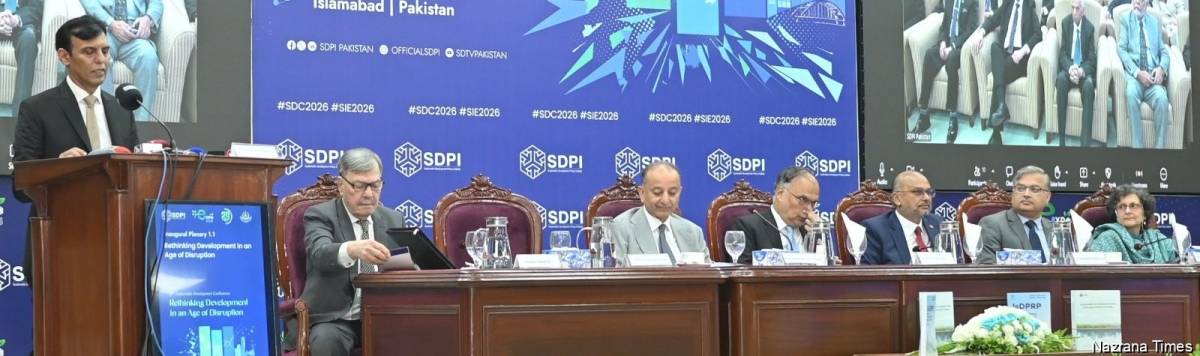
ISLAMABAD (Nazrana Times): Minister for Planning, Development and Special Initiatives Prof. Ahsan Iqbal has called for restructuring the international financial architecture established after the Second World War to address mounting debt, climate disasters and technological disruption.
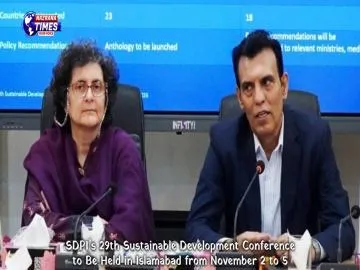
He was delivering the keynote address at the opening of the four-day 29th Sustainable Development Conference, organised by the Sustainable Development Policy Institute (SDPI) at Allama Iqbal Open University on Monday. This year’s overarching theme is “Rethinking Development in an Age of Disruption”.
Existing Financial Institutions Need Reform
Ahsan Iqbal said existing multilateral financial institutions lacked the capacity to respond adequately to 21st-century development challenges, particularly climate change and the growing financial vulnerabilities of developing countries.
He called for a new international financial architecture capable of supporting countries exposed to climate disasters and other emerging challenges.
The minister said Pakistan must respond proactively to technological transformation by investing in foundational education, scientific research, the capacity to absorb new technologies, entrepreneurship and stronger institutions.
He said Pakistan had set targets of becoming a $1 trillion economy by 2035 and a $3 trillion economy by 2047, when the country marks its centenary.
Bangladesh Adviser Proposes Regional Development Model
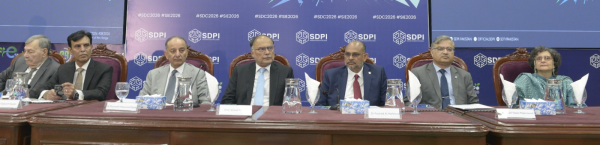
Adviser to the Bangladesh prime minister Rashid Almehmood Titumir called for a new South Asian development approach based on industrial transformation, regional production networks, decent employment and stronger social protection.
He said cooperation between Bangladesh and Pakistan could provide an example for the region.
Titumir said structural changes in the international economic and political order required developing countries to rethink conventional strategies and strengthen economic resilience.
He argued that current disruptions were reshaping the conditions for industrialisation, job creation, domestic resource mobilisation, development financing and economic sovereignty. Bangladesh, he added, aspired to become a manufacturing hub and export gateway by leveraging its geographical location.
Musadik Malik Advocates Equity Investment Over Further Borrowing
Federal Minister for Climate Change and Environmental Coordination Musadik Malik called for a pro-poor development model and rejected reliance on additional borrowing. He said Pakistan remained open to equity investment and debt swaps.
Malik said the country collected approximately PKR 16 trillion in revenue, of which around PKR 8 trillion went towards debt servicing. He described this as roughly 48–49% of total revenue.
He stressed that development must be equitable, durable and supported by greater national ownership.
AI Employment Opportunities and $10 Million Programme
Malik proposed using artificial intelligence to create employment opportunities rather than displace young workers. Graduates, he suggested, could help train AI systems in regional languages, including Balochi, Brahui, Sindhi and Urdu.
He announced a $10 million Green Field programme to provide young people with equity-based investment for scientific experimentation and innovative solutions. The first competition is planned within three months.
Conference Opens Alongside Sustainable Development Expo
SDPI Executive Director Dr Abid Qaiyum Suleri, Board of Governors Chairman Shafqat Kakakhel and Allama Iqbal Open University Vice-Chancellor Nasir Mahmood also addressed the opening session.
They highlighted sustainable development, regional cooperation and the need to adapt development strategies to emerging global challenges.
A subsequent plenary, titled “Connecting Ideas, Investment and Impact for Resilient Development”, examined how Pakistan could combine environmental sustainability, economic competitiveness and social equity.
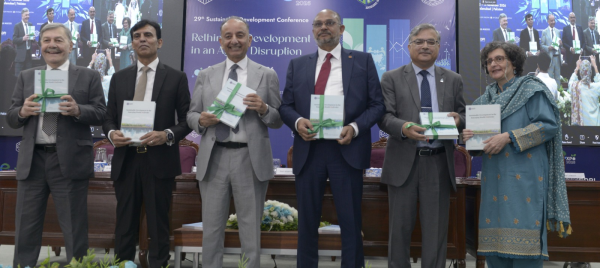
Federal Minister for Information Technology and Telecommunication Shaza Fatima Khawaja and the prime minister’s coordinator on climate change, Romina Khurshid Alam, attended the ribbon-cutting ceremony for the Sustainable Development Expo 2026.
The occasion also marked the launch of SDPI’s anthology, “Sustainable Development in the Emerging World Disorder”, incorporating policy recommendations from its 28th conference, alongside Volume 10 of the Journal of Development Policy Research and Practice.
Private Sector Must Be a Key Partner: Dr Suleri
Dr Suleri said the private sector must be recognised as a key partner in addressing climate change and advancing sustainable development. Governments alone, he said, could not mobilise all the financing, innovation and technical expertise required.
He noted that perceptions of environmental sustainability as a constraint on profitability were changing, with greener businesses increasingly demonstrating competitiveness and economic efficiency.
He urged Pakistani industries to prepare for evolving international trade requirements, including the European Union’s Carbon Border Adjustment Mechanism (CBAM), cleaner production standards and transparent carbon-emissions reporting.
Denmark Highlights Energy Efficiency and Green Cooperation
Danish Ambassador to Pakistan Martha Morsing said climate change, water scarcity and resource constraints posed growing threats to economic stability, requiring cooperation among governments, businesses and research institutions.
Drawing on Denmark’s experience, she said economic growth and environmental protection could advance together, noting that her country had expanded its economy while reducing carbon emissions.
She described energy efficiency as the cheapest available energy resource and expressed Denmark’s commitment to stronger commercial cooperation with Pakistan in green energy, energy-efficient technologies and sustainable industrial solutions.
Pakistan Needs Over $550 Billion in Climate Investment: OICCI
Representing the Overseas Investors Chamber of Commerce and Industry (OICCI), Umar Ahsan described climate change as an existential challenge for Pakistan. Repeated disasters, he said, were weakening economic stability, livelihoods and development prospects.
He said the 2022 floods had caused more than $30 billion in damage and economic losses, diverting resources from education, healthcare and productive investment.
Citing OICCI’s report, “Climate Acceleration: From Commitment to Competitive Edge in a Decisive Decade”, he said Pakistan required more than $550 billion in climate-related investment through 2035, or approximately $50 billion annually.
He compared that requirement with combined federal and provincial development budgets of around $15 billion, saying public financing alone could not bridge the gap.
He called for greater private investment, bankable climate projects, predictable policies and improved access to concessional financing.
Social Equity Must Remain Central to Climate Action
Umar Ahsan said women, small farmers, vulnerable communities and small businesses needed access to resources that would help them adapt to water scarcity, flooding, extreme heat and agricultural disruption.
He urged businesses to adopt credible environmental reporting and avoid greenwashing. Policymakers and financial institutions, he added, should facilitate investment in climate-resilient infrastructure and sustainable production.
The event also featured Sustainability Awards recognising practical initiatives in climate adaptation, the circular economy, clean energy, sustainable agriculture, digital innovation and inclusive development.




Leave a Reply