
Pakistan’s Proposal for 12 Provinces Sparks Political Debate as Constitutional Hurdles Come into Focus
- Internationl
- (Asia/Kolkata)
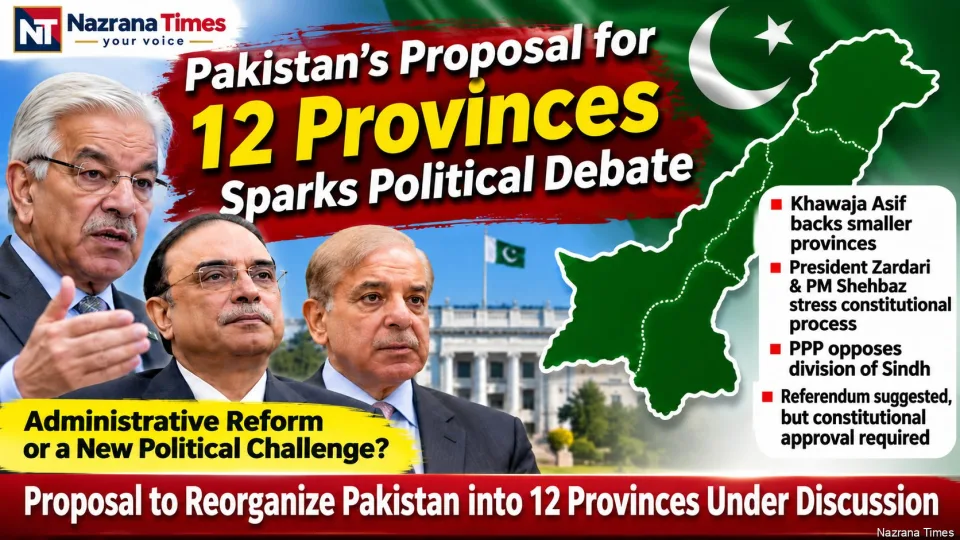
President Zardari and Prime Minister Shehbaz Sharif emphasize constitutional procedures; Defence Minister Khawaja Asif backs administrative restructuring, while PPP opposes the division of Sindh
Islamabad (Nazrana Times), November 17, 2026: A proposal to reorganize Pakistan into 12 administrative provinces has triggered a fresh political debate, raising questions about constitutional requirements, provincial autonomy, governance and the distribution of financial resources.
Defence Minister Khawaja Asif has supported the creation of smaller provinces on administrative grounds, arguing that Pakistan’s growing population and governance challenges require a more effective administrative structure.
However, the proposal remains under discussion. No final constitutional amendment has been approved, and no official boundaries for the proposed provinces have been finalized.
President and Prime Minister Stress Constitutional Procedures
The issue reportedly featured in discussions between President Asif Ali Zardari and Prime Minister Shehbaz Sharif during their meeting in Lahore on November 14.
According to media reports, both leaders emphasized that any proposal to create new provinces must follow the procedures established under Pakistan’s Constitution.
Interior Minister Mohsin Naqvi has also suggested holding a referendum to seek public opinion on the issue. However, a referendum alone would not replace the constitutional requirements for altering provincial boundaries.
Khawaja Asif Supports Administrative Restructuring
Defence Minister Khawaja Asif has argued that smaller provinces could improve governance, strengthen administrative efficiency and bring public services closer to citizens.
He has maintained that the creation of new provinces should be based on administrative needs rather than ethnic, linguistic or political divisions.
Asif has also raised concerns about the concentration of administrative powers and financial resources in provincial capitals, arguing that local institutions need greater authority and resources.
His latest remarks have renewed discussions about whether Pakistan’s existing provincial structure can adequately address the needs of its population.
PPP Opposes Division of Sindh
The proposal has also exposed differences among political parties.
The Pakistan Peoples Party (PPP) has strongly opposed any attempt to divide Sindh province.
PPP Chairman Bilawal Bhutto Zardari and Sindh Chief Minister Murad Ali Shah have previously expressed opposition to the province’s division.
The Sindh Assembly has also adopted a resolution opposing the division of the province.
These differences could complicate efforts to build the political consensus required for constitutional restructuring.
What Does Pakistan’s Constitution Say?
Article 239(4) of Pakistan’s Constitution requires a constitutional amendment affecting the boundaries of a province to receive approval from the relevant provincial assembly by a two-thirds majority.
Consequently, creating new provinces would require more than political declarations or a public referendum.
The proposal would need to pass through the constitutional amendment process, including the required parliamentary approvals and consent of the affected provincial assemblies.
Proposal to Divide Existing Provinces
One proposal discussed in media reports envisages dividing Punjab into four provinces, Khyber Pakhtunkhwa and Balochistan into three each, and Sindh into two.
However, this arrangement has not been adopted as an official government plan.
No final map, administrative boundaries, provincial capitals or implementation schedule has been formally approved.
Governance Reform or New Political Challenges?
Supporters argue that smaller provinces could improve administrative accessibility, public service delivery and regional development.
Critics, however, question whether creating additional provincial governments would increase administrative expenditure, intensify political disagreements or create disputes over resources and territorial boundaries.
The debate also raises broader questions about strengthening local governments and ensuring that development funds reach underserved districts.
For now, Pakistan’s proposed provincial restructuring remains a political and constitutional debate rather than an approved reform.
Its future will depend on parliamentary deliberations, provincial consent and the ability of political parties to reach a broader consensus.




Leave a Reply