
Services Sector Leads Pakistan’s Economic Growth in FY26
- Internationl
- (Asia/Kolkata)
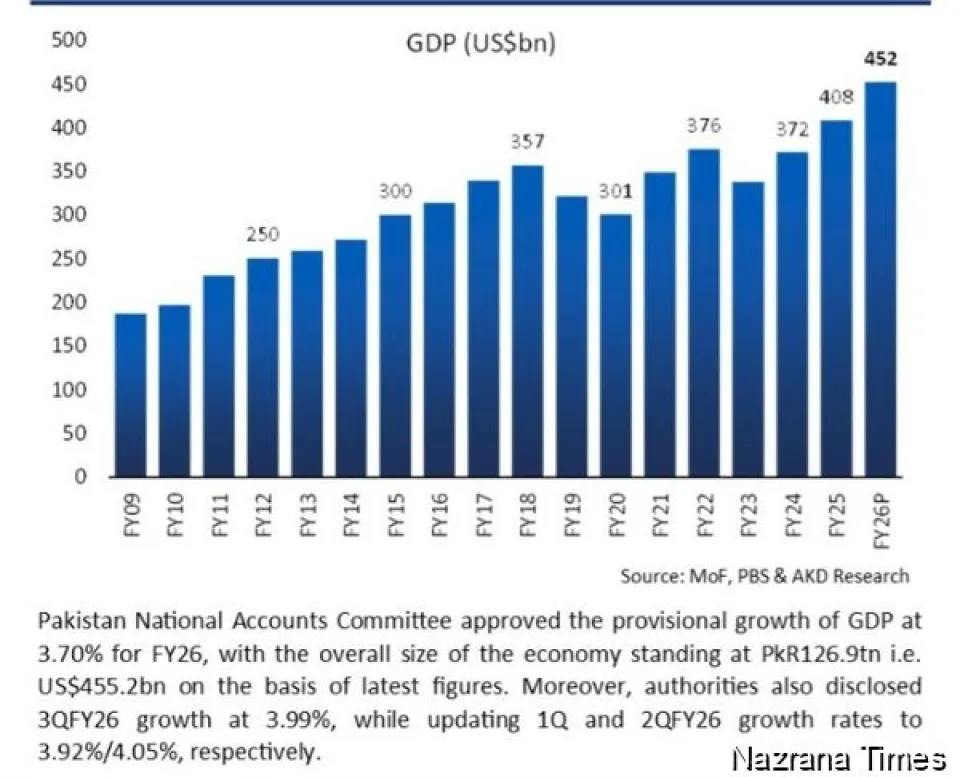
Pakistan’s Economy Expands to $452 Billion in FY 2025–26
Islamabad
Ali imran Chattha
Pakistan’s economy has reached a significant milestone, with its nominal GDP estimated at $452.1 billion (Rs126.9 trillion) for the fiscal year 2025–26, according to provisional figures approved by the National Accounts Committee (NAC). This marks a notable increase from Rs114 trillion ($408.2 billion) recorded in the previous fiscal year, reflecting a steady recovery in economic activity.
The economy grew by 3.7 per cent during the year, surpassing earlier projections by major international institutions. The World Bank had forecast growth at around 3.0 per cent, while the International Monetary Fund (IMF) anticipated approximately 3.6 per cent. Moody’s had projected growth in the range of 3.1 to 3.5 per cent. The stronger-than-expected performance suggests improving macroeconomic stability and resilience amid global economic uncertainties.
Per capita income rose to $1,901 (Rs533,629), indicating gradual improvements in average income levels, although it still reflects ongoing challenges related to population growth and income distribution.
Sector-wise performance showed broad-based growth across the economy:
Services sector expanded by 4.09 per cent, remaining the primary driver of overall GDP growth, supported by trade, transport, and financial services.
Industry grew by 3.51 per cent, aided by modest recovery in manufacturing and construction activity.
Agriculture recorded growth of 2.89 per cent, reflecting stable crop output despite climate-related pressures.
Quarterly data indicates strengthening economic momentum, with growth reaching 3.99 per cent in the third quarter, suggesting improved performance towards the end of the fiscal year.
Pakistan now ranks as the 42nd largest economy in the world in nominal terms. Officials attribute this growth to improved external sector indicators, including higher workers’ remittances, relative exchange rate stability, and tighter fiscal and monetary management.
The figures were finalised during the 117th NAC meeting held on 13–14 May 2026 under the Ministry of Planning, Development and Special Initiatives. As with all provisional estimates, the data may be subject to revision in subsequent NAC reviews.
Sources: National Accounts Committee (NAC), Pakistan Bureau of Statistics (PBS), Ministry of Planning, Development and Special Initiatives, World Bank, IMF, and Moody’s.





Leave a Reply