
Pakistan Lays Groundwork for Semiconductor and Microchip Industry
- Internationl
- (Asia/Kolkata)
ISLAMABAD — Nazrana Times Ali Imran Chattha
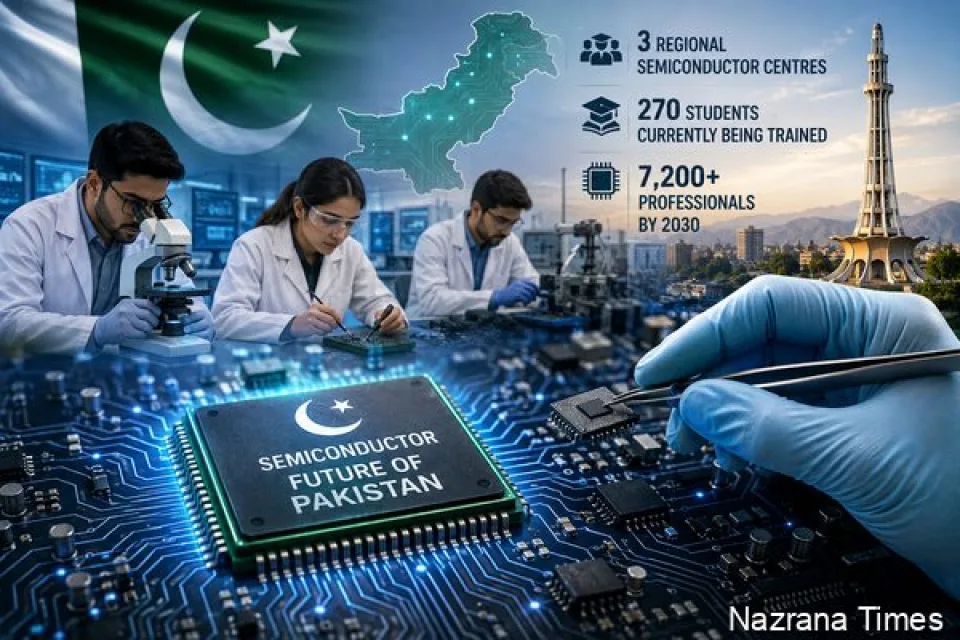
Pakistan has taken steps towards developing a domestic semiconductor ecosystem with the establishment of three regional semiconductor education and research centres aimed at building a skilled workforce and strengthening the country's capacity in microchip design and related technologies.
The three centres are being led by the National University of Sciences and Technology (NUST) for the northern region, the University of Engineering and Technology (UET) Lahore for the central region, and NED University of Engineering and Technology, Karachi, for the southern region.
Under the government-backed semiconductor skills and research initiative, 270 students are currently being trained. Pakistan has also set a target of producing more than 7,200 semiconductor professionals by 2030.
The initiative focuses on developing expertise in areas including semiconductor design, integrated circuits, chip development and advanced electronics, while establishing an academic and research base for the potential future growth of the industry.
The programme is being viewed as a step towards reducing dependence on imported semiconductor expertise and enabling Pakistan to participate in the expanding global semiconductor industry.
However, training and research infrastructure is distinct from commercial-scale semiconductor manufacturing. While commercial chip manufacturing in Pakistan could potentially emerge around 2030–2032 if the necessary ecosystem, investment and infrastructure develop successfully, this timeframe remains a projection and should not be considered a confirmed government launch date.
For now, Pakistan's focus remains on developing skilled human resources, research capabilities and semiconductor design expertise — key foundations for a potential domestic microchip industry.
Nazrana Times Fact Check
The establishment of three regional semiconductor centres and the target of training more than 7,200 professionals by 2030 are supported by government information. However, claims that commercial microchip manufacturing will definitely begin between 2030 and 2032 remain projections rather than a confirmed launch date.







Leave a Reply