
Pakistan Extends Airspace Ban on Indian Flights Until July 24 Move Sustains Retaliatory Measures Imposed During 2025 Military Standoff
- Internationl
- (Asia/Kolkata)
ISLAMABAD Nazrana Times!
Report Ali imran Chattha
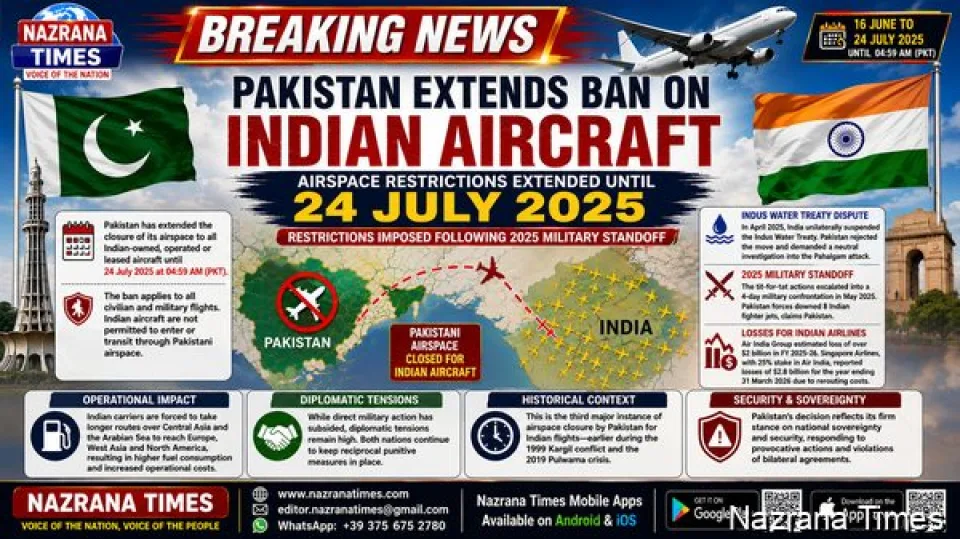
Pakistan has formally extended the closure of its airspace to all Indian-registered civilian and military aircraft until 4:59 AM on July 24, marking another 30-day renewal of restrictions first imposed in April 2025.
The fresh extension, effective from June 16, maintains a blanket prohibition on Indian-owned, operated, or leased aircraft traversing Pakistani skies. The ban remains strictly enforced across all civilian and military aviation categories.
Bilateral Tensions Persist
The airspace closure was initially enacted as a countermeasure following India’s unilateral suspension of the Indus Water Treaty in April 2025, which New Delhi justified in the aftermath of the Pahalgam attack. Islamabad rejected accusations of complicity in the incident and called for an independent investigation.
The subsequent tit-for-tat restrictions escalated into a four-day military confrontation in May 2025, which was ultimately de-escalated through a United States-brokered ceasefire. Pakistani forces reportedly downed eight Indian fighter jets during the skirmish.
Financial Toll on Indian Aviation
The prolonged ban has inflicted substantial financial damage on Indian carriers. Air India Group is estimated to have suffered losses exceeding $2 billion during the 2025-26 fiscal year. Singapore Airlines, holding a 25 percent stake in the Indian flag carrier, posted losses of approximately $2.8 billion for the period ending March 31, 2026, citing rerouting costs as a primary factor.
The airline has been compelled to significantly curtail international frequencies, hampering its broader restructuring agenda under the Tata Group.
Operational Disruptions
Indian carriers are forced to navigate extensive detours over Central Asia and the Arabian Sea to reach European, West Asian, and North American destinations, driving up fuel and operational expenses. While kinetic military engagements have subsided, diplomatic friction persists, with both nations retaining their reciprocal punitive measures.
Historical Precedent
This marks the third major instance of such a closure, following similar bans during the 1999 Kargil conflict and the 2019 Pulwama crisis. In both previous episodes, Indian aviation faced disproportionately greater disruption compared to Pakistan due to the geographic positioning of its major international routes.






Leave a Reply